How to identify a first edition
First edition usually means the first printing of the first edition. Proving it takes more than a line on the copyright page.
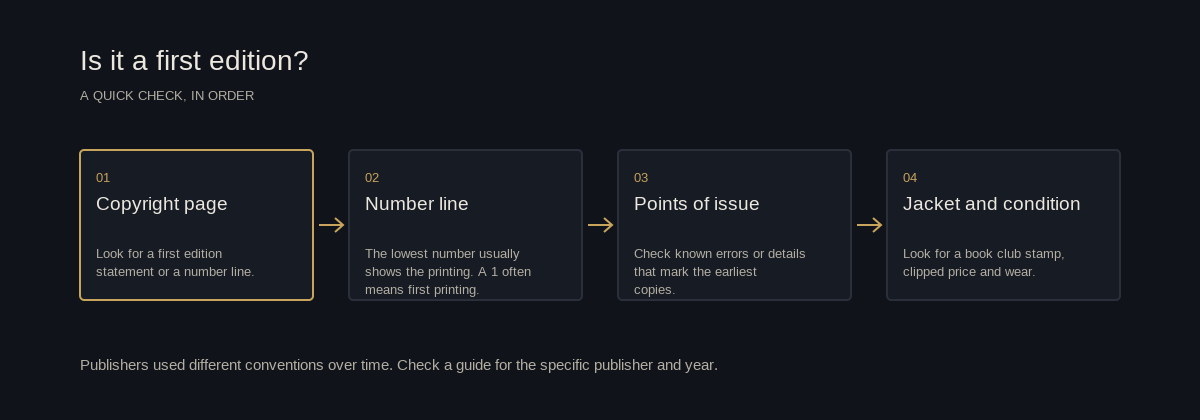
The copyright page
Start on the back of the title page. Many publishers print First Edition or First Printing there. Many modern books also carry a number line, a row such as 10 9 8 7 6 5 4 3 2 1. Printers remove a number with each new printing, so the lowest number usually tells you which printing you hold.
Conventions vary. Some publishers never stated first editions. Some kept the words First Edition on later printings. Guides that list publishers’ practices by year exist for exactly this reason.
Points of issue
For famous books, collectors know small details that mark the earliest copies: a typo later corrected, a binding color, an advertisement in the back. These are called points of issue. They separate a true first printing from later copies with the same date.
Book-club editions
Book clubs printed millions of copies that look like trade firsts. Signs include a smaller size, thinner paper, no price on the jacket flap, the words Book Club Edition on the jacket, and a small blind stamp, an uninked dent, on the back board. These copies are rarely worth much.
The jacket counts
For many twentieth-century books, the dust jacket carries most of the value. A clipped price corner, tears and fading all lower it. Married jackets, from another copy, are common. If a book seems valuable, ask a member of the ABAA or ILAB for an opinion. Next, read how to care for leather bindings.
Common questions
Is every first edition valuable?
No. Most first editions are worth little. Value depends on the title’s importance, demand, scarcity and condition.
Does a signature add value?
It can, if it is authentic and the author is collected. An inscription to a notable person, called an association copy, can add more.